
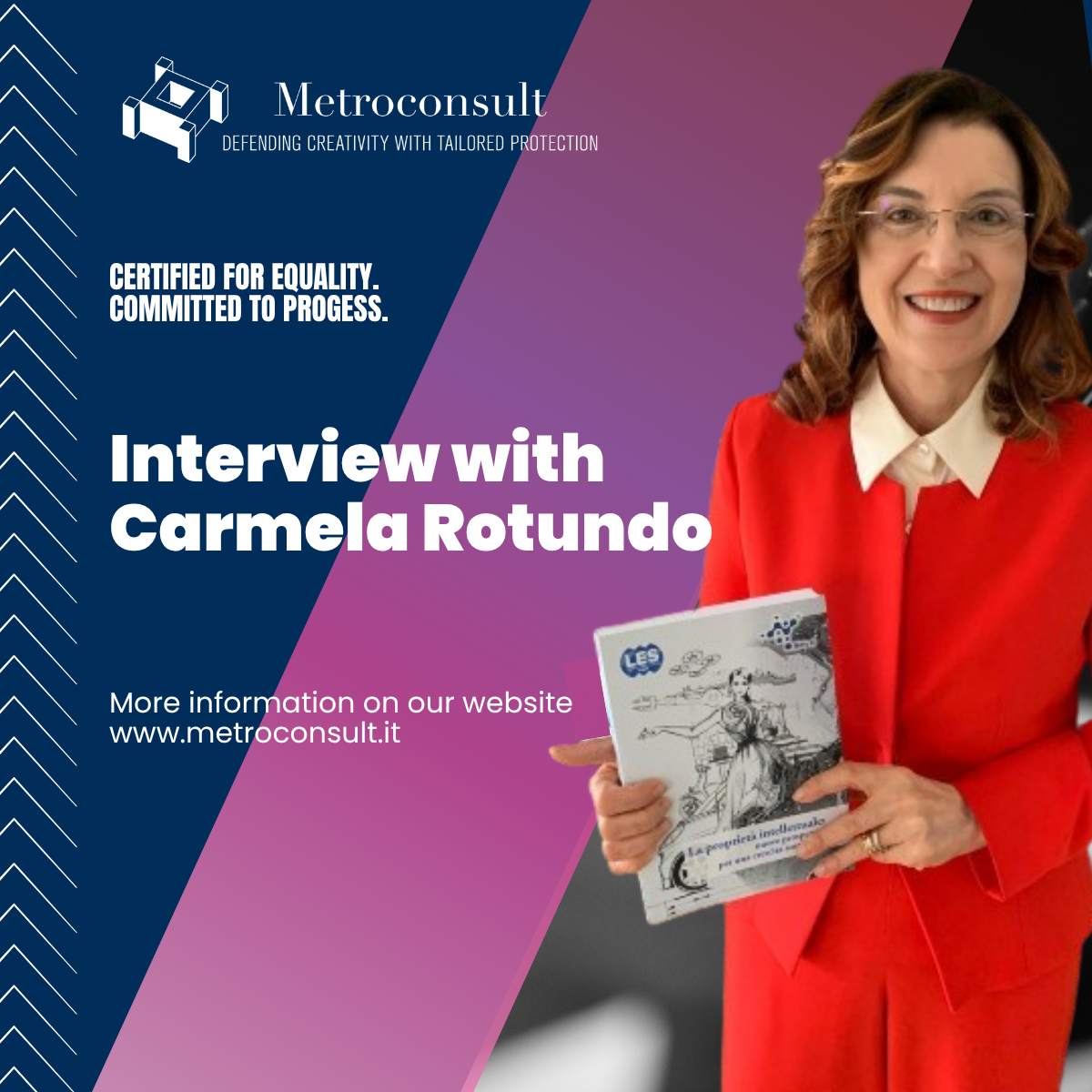
Intellectual property plays a crucial role in protecting creativity, innovation, and commercial value in an increasingly globalized economy. In this interview, Carmela Rotundo shares her professional journey into intellectual property, reflecting on how a chance opportunity developed into a long-standing career as a trademark and design attorney. She discusses the nature of her day-to-day work, her approach to client advice and dispute resolution, and offers insight into the evolving role of women within the IP profession in Italy and across Europe.
What initially attracted you to intellectual property and how did your career evolve into your current role?
I came across this profession by chance when I started working for a car manufacturer which was also involved in the marketing of merchandising and in the publication of a review. Working in the different departments, I liked the IP division and started working with the lawyer responsible for patents, trademarks and designs of this company. I liked trademarks and the international environment surrounding IP very much and when I moved to the US with my husband, I found a job as a trainee in a trademark law firm and then I read a masters degree in Strasbourg, France in IP (trademarks and designs). Once back in Italy, I passed the relevant exam to become a trademark and design attorney, I have been working in this field now for the past 25 years.
What does a typical day look like for you today and which part of your work do you enjoy most?
I like giving advice to clients on trademark matters. My typical day is giving advice on whether a sign is registrable as a mark as well as conducting availability searches in order to ascertain whether a mark can be filed on behalf of our clients, filing the same, filing oppositions and cancellation actions against identical or confusingly similar marks belonging to third parties. I also believe very much in Alternative Dispute Resolution which allows clients to solve matters quickly and with limited costs. I refer to mediation, expert determination, administrative proceedings for the re-assignment of domain names. Recently, I have been appointed as mediator at the PMAC, the Patent Mediation and Arbitration Center of the Unified Patent Court (UPC).
The following is what was recently written about me:
“She gives very sensible, sophisticated advice and takes commercial realities into consideration. Carmela always goes the extra mile and makes sure that clients receive excellent results”.
Advising clients on whether their sign is registrable as a mark avoids office actions. Conducting availability searches in order to ascertain whether a mark can be filed on behalf of our clients avoids third parties’ oppositions. This makes sure that clients receive excellent results.
In court-related IP settings have you ever felt your authority was questioned differently because you are a woman? What did you do at that moment?
I have recently been appointed by a (male) judge as a CTU, Expert in a design and copyright case. I feel very honored to be appointed for such an important role. In court- related cases, I have never felt discriminated for the fact that I am a woman.
Over the years have you seen a shift in how women are represented or valued in IP consulting and litigation-adjacent work in Italy or the EU?
I believe that, over the last ten years, women have become increasingly represented in the IP profession. For example, during this period, the Italian Institute of IP Consultants has had a woman serving as its President, and in recent years women have held five of the ten seats on the governing Board. These are encouraging signs of progress, and I believe that women are playing an ever more significant role in our profession.
Carmela’s experience highlights how intellectual property law combines legal expertise with strategic and commercial awareness. Her career illustrates the importance of careful advisory work, proactive risk prevention, and efficient dispute resolution in delivering strong outcomes for clients. At the same time, her reflections on gender representation show encouraging progress within the IP field, with women increasingly recognized in leadership and expert roles. Her journey serves as both an example of professional dedication and a positive indicator of the continued evolution of the IP profession.
In 2025, Metroconsult obtained the Gender Equality Certification (UNI/PdR 125:2022) as part of its ongoing commitment to fostering an inclusive and equitable workplace culture.
In support of this initiative, under the project #CertifiedForEqualityCommittedToProgress, Metroconsult collaborated with a group of students from ESCP Business School on a project aimed at raising awareness about the role of women in the intellectual property sector.
This article, together with other content published on the Metroconsult website and on the company’s LinkedIn page, forms part of this awareness and communication initiative.